Deep TMS is a non-invasive, FDA-cleared treatment that uses magnetic pulses to stimulate brain circuits involved in depression and OCD. At Hamilton Psychiatric Services in Hamilton, NJ, Dr. Mirza offers BrainsWay Deep TMS for treatment-resistant depression, OCD, and smoking addiction.
TMS is non-invasive, requires no anesthesia, and has no systemic side effects. Most patients drive themselves to every appointment and return to normal daily activities immediately afterward.
Request a TMS ConsultationWhat Is TMS Therapy?
Transcranial Magnetic Stimulation (TMS) is a non-invasive, FDA-cleared treatment that uses precisely targeted magnetic pulses to stimulate the neural circuits in the brain that are underactive in depression and other psychiatric conditions. Unlike antidepressant medications, TMS acts directly on the brain — with no drug circulating through your bloodstream and no systemic side effects such as weight gain, sexual dysfunction, or sedation.
TMS has been FDA-cleared for depression since 2008. BrainsWay Deep TMS — the technology used at Hamilton Psychiatric Services — received additional FDA clearance for OCD in 2018 and smoking cessation in 2020, and has accumulated more clinical evidence than any other TMS device on the market.
Our Deep TMS program is FDA-cleared for major depressive disorder and OCD. We do not offer TMS for migraine or headache treatment.
BrainsWay Deep TMS — A Step Above Standard TMS
Not all TMS is the same. Hamilton Psychiatric Services uses BrainsWay Deep TMS, which differs from conventional figure-8 TMS in two important ways:
- Deeper reach: BrainsWay's patented H-Coil technology stimulates deeper and broader areas of brain tissue — reaching structures involved in mood regulation that conventional coils cannot access
- Better outcomes: Clinical studies report remission rates of 51%–75% in treatment-resistant patients, significantly higher than conventional TMS
Developed at the National Institutes of Health (NIH) and used by leading medical centers worldwide, BrainsWay Deep TMS is the same technology trusted by Johns Hopkins, Harvard, and hundreds of specialized psychiatric practices across the country.
Who Is a Candidate for TMS?
TMS is most often recommended for patients who have not responded adequately to one or more antidepressant medications — a condition known as treatment-resistant depression. You may be a good candidate if:
- You have tried two or more antidepressants at adequate doses without sufficient relief
- You experience intolerable side effects from psychiatric medications
- You prefer a drug-free approach to treating depression
- You have been diagnosed with OCD that has not responded to medication and therapy
- You are seeking support to quit smoking
TMS is generally not appropriate for patients with metallic implants in or near the head (such as cochlear implants or aneurysm clips), a history of seizures, or certain other neurological conditions. Dr. Mirza conducts a thorough evaluation before recommending TMS to ensure it is safe and appropriate for each patient.
Conditions Treated with Deep TMS
- Treatment-Resistant Depression (TRD) — for patients who have not improved with two or more antidepressants
- Major Depressive Disorder (MDD) — including patients who prefer a non-medication approach
- Obsessive-Compulsive Disorder (OCD) — FDA-cleared BrainsWay protocol targeting the medial prefrontal cortex and anterior cingulate cortex
- Smoking & Nicotine Addiction — FDA-cleared for smoking cessation support
- Anxious Depression — BrainsWay has demonstrated efficacy for depression with comorbid anxiety symptoms
What to Expect: The TMS Treatment Course
Initial Consultation
Your first step is a psychiatric evaluation with Dr. Mirza to confirm your diagnosis, review your treatment history, and determine whether TMS is the right next step. If TMS is recommended, Dr. Mirza will guide you through the process and coordinate insurance authorization.
The Treatment Schedule
A standard course of BrainsWay Deep TMS consists of 36 sessions of 20 minutes each:
- Weeks 1–4: 5 sessions per week (acute phase)
- Weeks 5–6: tapering maintenance sessions as clinically appropriate
Most patients begin noticing improvement within 2–3 weeks. The full benefit is typically realized by the end of the treatment course. You can drive yourself to every session and return to work immediately after — there is no recovery time required.
During a Session
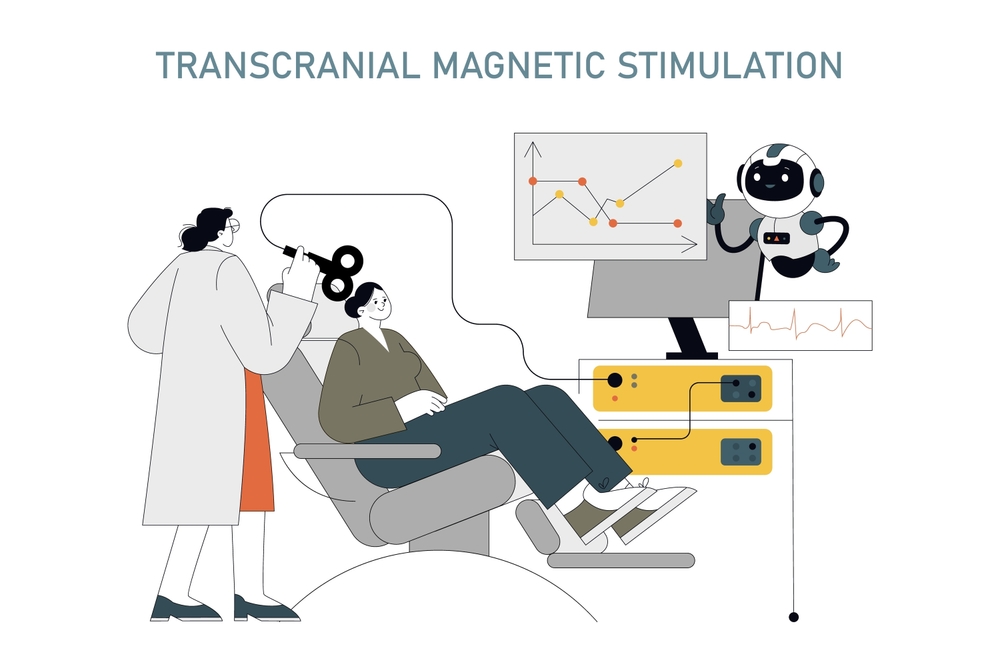
You sit comfortably in a chair wearing a cushioned helmet that delivers the magnetic pulses. You will hear clicking sounds and feel a tapping sensation on your scalp. Sessions last approximately 20 minutes. You remain awake and alert throughout — many patients read, listen to music, or simply relax.
Continuing Medications
In most cases, patients continue their current medications during TMS. As the treatment progresses and symptoms improve, Dr. Mirza will work with you to evaluate whether medication adjustments are appropriate.
Insurance Coverage for TMS in NJ
BrainsWay Deep TMS is covered by most major insurance plans and Medicare for treatment-resistant depression when clinical criteria are met. Coverage criteria typically require documentation of at least two adequate antidepressant trials that failed to produce sufficient response.
Hamilton Psychiatric Services will work with you to verify your benefits and obtain prior authorization before beginning treatment. Our team is experienced in navigating insurance requirements to minimize out-of-pocket costs for our patients.
Insurance plans that commonly cover TMS include: Aetna, Cigna, United Healthcare, Horizon BCBS NJ, and Medicare. Coverage varies by plan — contact our office to verify your specific benefits.
Why Choose Hamilton Psychiatric Services for TMS?
- 30+ years of board-certified psychiatric expertise — Dr. Mirza brings decades of experience to every TMS evaluation and treatment plan
- BrainsWay technology — the most clinically validated Deep TMS system, with superior depth and breadth of stimulation vs. conventional TMS
- Personalized care — TMS is not a standalone procedure here; it is integrated into a comprehensive psychiatric treatment plan tailored to you
- Convenient Hamilton, NJ location — easily accessible from Trenton, Princeton, Ewing, Bordentown, and surrounding areas
- Insurance navigation support — our team handles prior authorization so you can focus on getting better
Frequently Asked Questions About TMS
Is TMS painful?
TMS is not painful. Most patients describe the sensation as a tapping or knocking feeling on the scalp during stimulation. Some patients experience mild scalp discomfort or a headache after the first few sessions, which typically resolves quickly and diminishes over the course of treatment.
What are the side effects of TMS?
The most common side effects are mild scalp discomfort and headache, which tend to diminish after the first week. TMS does not cause the systemic side effects associated with antidepressant medications — no weight gain, no sexual dysfunction, no sedation, no memory impairment. The risk of seizure is very low (approximately 1 in 30,000 sessions).
How long do the results of TMS last?
Many patients maintain significant improvement for 12 months or longer after completing a TMS course. For patients who experience a return of symptoms, a second course of TMS is often effective. Ongoing psychiatric care — including medication management and follow-up — helps sustain the gains made during treatment.
Can I work during TMS treatment?
Yes. TMS requires no anesthesia, no sedation, and no recovery time. The vast majority of patients drive themselves to appointments and return to their normal activities — work, errands, exercise — immediately after each session.
How do I get started?
Contact Hamilton Psychiatric Services to schedule a TMS consultation with Dr. Mirza. We will review your history, confirm whether TMS is appropriate, and begin the insurance authorization process. Call us at 609-631-7770 or submit an appointment request online.